On-Page SEO & Content Optimization: Titles, Headings, Links & E-E-A-T
A practical deep dive into title tags, meta descriptions, heading hierarchy, internal linking, image SEO, and E-E-A-T signals that improve rankings and click-through rates.
What Is On-Page SEO?
On-page SEO (also called on-site SEO) is the practice of optimizing individual web pages to rank higher in search engines and earn more relevant organic traffic. It includes everything you control directly on the page: title tags, meta descriptions, heading structure, body content, internal links, image optimization, URL slugs, and user experience elements. On-page SEO works together with technical SEO (site-wide infrastructure) and off-page SEO (backlinks and brand signals) to determine your position in the SERP.
Strong on-page optimization aligns each page with a primary search intent — informational, navigational, commercial, or transactional — and makes it easy for both users and crawlers to understand what the page is about and why it deserves to rank.
Title Tags: Your Most Important On-Page Ranking Element
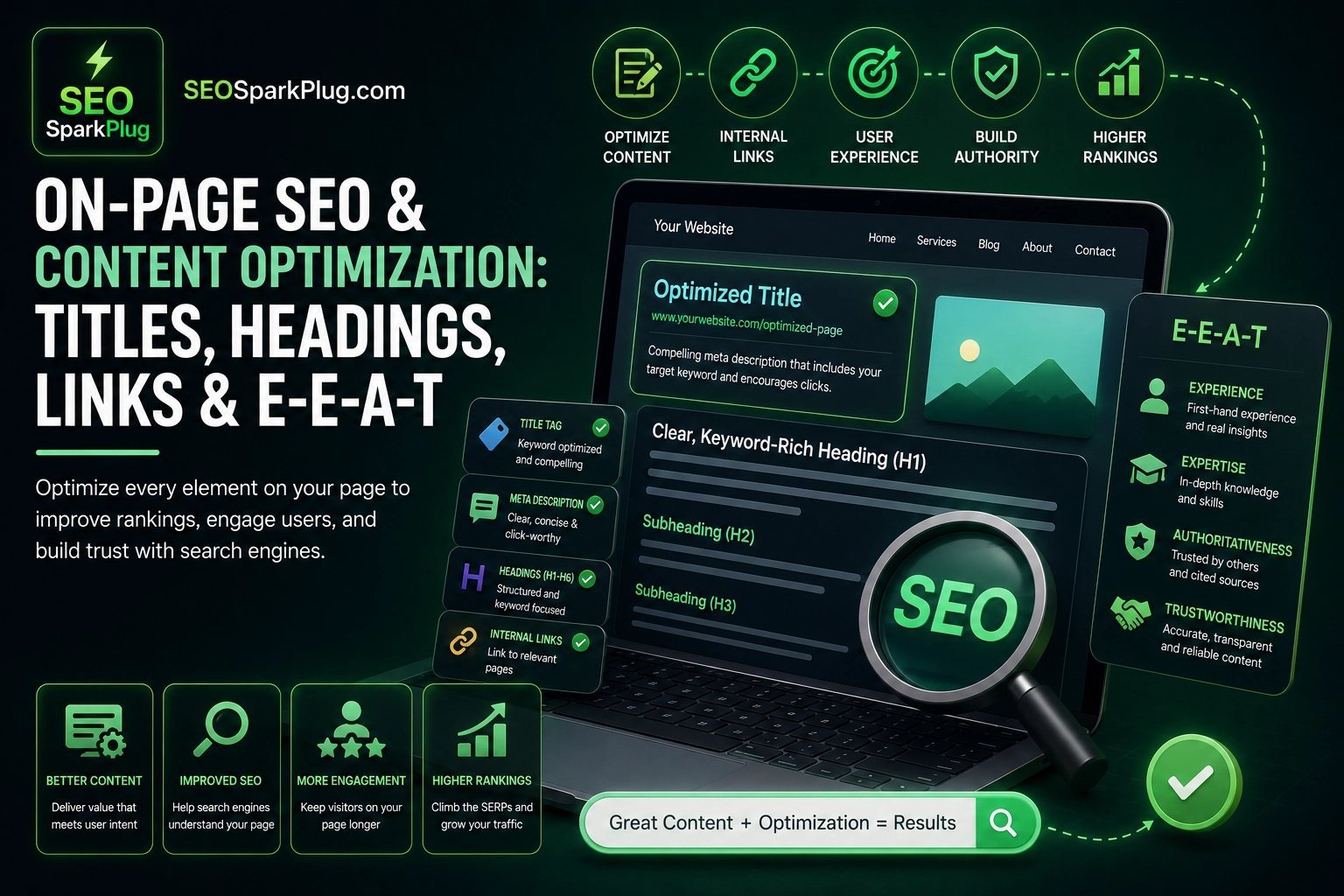
The title tag (the <title> element) is the clickable headline in search results and a primary relevance signal. Best practices:
- Place your primary keyword near the beginning when natural.
- Keep titles roughly 50–60 characters to avoid truncation in the SERP.
- Make every title unique across your site — duplicate titles confuse crawlers.
- Write for humans first: compelling titles improve click-through rate (CTR), which indirectly supports rankings.
- Include brand name at the end for recognition (e.g., "Technical SEO Guide | SEO SparkPlug").
Google may rewrite titles that mismatch page content or appear keyword-stuffed. Ensure your visible H1 and title tag are closely aligned in topic and intent.
Meta Descriptions and SERP Click-Through Rate
Meta descriptions are not a direct ranking factor, but they strongly influence CTR — the percentage of searchers who click your result. Higher CTR can correlate with better engagement signals. Write 150–160 character descriptions that summarize the page value proposition, include a call to action, and use your target keyword naturally (Google often bolds matching terms).
Avoid duplicate meta descriptions site-wide. For large ecommerce or programmatic sites, generate unique descriptions from product attributes or use templated patterns with unique variables.
Heading Hierarchy: H1 Through H6
Headings structure content for accessibility, readability, and SEO. Use one H1 per page that clearly states the main topic. Break content into logical H2 sections, with H3 and below for subsections. Headings should describe the content that follows — not be used purely for styling.
- H1: Primary page topic (matches search intent).
- H2: Major sections (subtopics, questions).
- H3–H6: Nested detail within sections.
Semantic SEO benefits when headings incorporate related terms and synonyms (LSI keywords) — not repetitive exact-match stuffing. Cover the topic comprehensively so the page satisfies the full breadth of user intent.
Content Quality, Depth, and Search Intent
Google's helpful content systems reward pages that demonstrate first-hand experience and satisfy the reason behind a search query. Match intent types:
- Informational: Guides, tutorials, definitions — answer the question thoroughly.
- Commercial investigation: Comparisons, reviews, "best of" lists — help users decide.
- Transactional: Product and pricing pages — remove friction to convert.
- Navigational: Brand or login pages — make finding the destination instant.
Aim for content depth that exceeds thin competitors without adding fluff. Use original research, examples, screenshots, and updated dates where appropriate. Avoid duplicate content across URLs — consolidate with canonicals or 301 redirects.
E-E-A-T: Experience, Expertise, Authoritativeness, Trustworthiness
E-E-A-T is Google's quality framework, especially critical for YMYL (Your Money or Your Life) topics — health, finance, legal, safety. Strengthen E-E-A-T on every page:
- Experience: Show real-world usage, case studies, and first-hand results.
- Expertise: Author bios with credentials, citations to primary sources.
- Authoritativeness: Backlinks, brand mentions, industry recognition.
- Trustworthiness: HTTPS, clear contact info, privacy policy, accurate facts, review transparency.
Internal Linking Strategy
Internal links distribute PageRank (link equity) across your site and help crawlers discover pages. Best practices:
- Link from high-authority pages (homepage, popular posts) to priority landing pages.
- Use descriptive anchor text — avoid generic "click here" links.
- Build topical clusters: pillar pages linking to related subtopic articles (hub-and-spoke model).
- Fix orphan pages by adding at least one contextual internal link to each indexable URL.
- Audit broken internal links regularly — 404s waste equity and hurt UX.
Image SEO and Media Optimization
Images affect page speed, accessibility, and image search visibility. Optimize every image:
- Alt text: Describe the image for screen readers and context — include keywords when relevant.
- File names: Use descriptive slugs (technical-seo-audit.png, not IMG_2847.jpg).
- Compression: Serve WebP or AVIF formats with appropriate dimensions.
- Lazy loading: Defer off-screen images to improve LCP.
URL Structure and Slug Optimization
Clean, readable URLs help users and search engines. Use lowercase hyphen-separated slugs (/learn/technical-seo-guide), keep URLs short, include primary keywords, and avoid unnecessary parameters. Changing URLs requires 301 redirects from old paths to preserve rankings.
On-Page SEO Checklist for Every New Page
- Unique, keyword-informed title tag and meta description.
- One clear H1 aligned with target query intent.
- Logical H2/H3 structure with comprehensive body content.
- Primary keyword in first 100 words — used naturally throughout.
- At least 2–3 contextual internal links to and from related pages.
- Optimized images with alt attributes.
- Schema markup where applicable (Article, FAQ, Product).
- Mobile-friendly layout and fast load time.
- Author attribution and date published/updated for trust.
Conclusion: On-Page SEO Is Where Rankings Are Won Page by Page
Every URL on your site is a ranking opportunity. On-page SEO ensures each page sends clear relevance, quality, and trust signals to search engines while delivering the experience users expect. Combine disciplined on-page work with technical audits and AIO readiness for full-spectrum visibility. Use SEO SparkPlug to score pages, prioritize fixes, and track improvements in your SEO dashboard over time.