
How SEO Ranking Has Changed Over the Years: A 2026 Perspective
Track the evolution of SEO from keyword stuffing to AI-powered algorithms, mobile-first indexing, and user experience optimization.
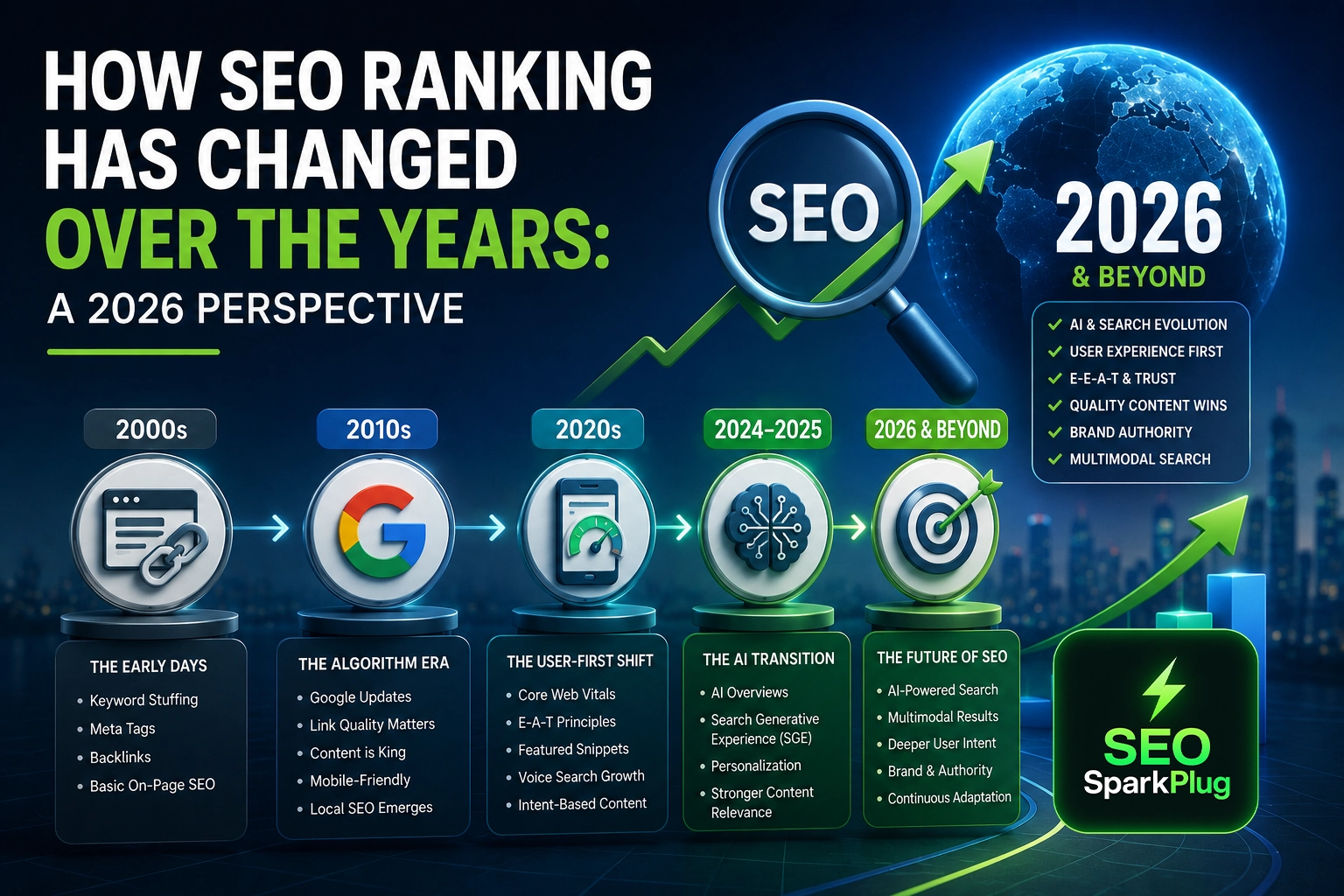
The Evolution of SEO: From Keyword Stuffing to AI-Powered Algorithms
SEO has undergone dramatic transformations since the early days of search engines. Understanding how SEO ranking has changed over the years helps us appreciate current SEO best practices and anticipate future trends. This journey from simple keyword matching to sophisticated AI-driven optimization reflects the evolution of both search technology and user expectations.
The Early Days: 1990s - 2000s (The Wild West)
In the early days of SEO, ranking was primarily about keyword density and basic on-page factors. Website owners could achieve top rankings by:
- Keyword stuffing: Loading pages with target keywords, often making content unreadable
- Meta keyword tags: Placing keywords in meta tags (a practice that eventually became irrelevant)
- Simple title optimization: Putting exact keywords in page titles
Search algorithms were basic, focusing mainly on keyword matching rather than content quality or user experience. This era lacked sophisticated SEO tools, making optimization a guessing game.
The PageRank Revolution: Late 1990s - Early 2000s
Google's introduction of PageRank in 1998 revolutionized SEO ranking. For the first time, the quality and quantity of backlinks became critical ranking factors. This period marked the beginning of:
- Link building as a core SEO strategy
- Understanding domain authority and link value
- The importance of earning links from authoritative sites
However, this also led to manipulative practices like link farms and paid link schemes, which search engines would later penalize.
The Algorithm Updates Era: 2000s - 2010s
Major Google algorithm updates fundamentally changed SEO ranking factors:
Florida (2003) - The First Major Shake-Up
Google's Florida update penalized keyword stuffing and over-optimization, forcing SEO practitioners to focus more on natural keyword usage and content quality.
Panda (2011) - Content Quality Matters
The Panda update targeted low-quality, thin content sites. This update emphasized:
- Content depth and value
- Reducing duplicate content
- Prioritizing quality over quantity in content creation
This marked a shift toward content marketing as an essential SEO component.
Penguin (2012) - Link Quality Over Quantity
Penguin penalized manipulative link building, making quality backlinks more important than quantity. This update:
- Penalized link farms and paid link schemes
- Emphasized earning natural, relevant backlinks
- Made link profile quality a critical SEO ranking factor
Hummingbird (2013) - Semantic Search
Hummingbird introduced semantic search capabilities, allowing Google to understand search intent and context rather than just matching keywords. This update:
- Moved beyond exact keyword matching
- Emphasized topic relevance and related keywords
- Improved understanding of user search intent
This development made keyword analysis more sophisticated, requiring SEO tools that could analyze semantic relationships.
The Mobile-First Revolution: 2015 - Present
With the Mobilegeddon update in 2015, mobile optimization became crucial for SEO ranking. Google's mobile-first indexing, introduced in 2018, means Google primarily uses the mobile version of content for indexing and ranking.
Key Changes:
- Page speed became a major ranking factor
- Mobile-friendly design became essential
- Technical SEO focused heavily on responsive design and mobile performance
- SEO tools began emphasizing mobile SEO score metrics
The User Experience Era: 2010s - 2020s
Modern SEO ranking increasingly prioritizes user experience signals:
- Core Web Vitals (2021): Metrics like page load speed, interactivity, and visual stability directly impact SEO ranking
- Bounce rate and engagement: Time on site, pages per session, and return visits signal content quality
- Schema markup: Structured data helps search engines understand content and enhances SERP appearance
This shift made on-page SEO more holistic, focusing on creating valuable experiences rather than just optimizing technical elements.
The AI and Machine Learning Era: 2020s - Present
Current SEO ranking algorithms use sophisticated AI and machine learning:
- BERT and MUM: Google's AI models better understand natural language, context, and user intent
- RankBrain: Machine learning helps interpret search queries and determine the most relevant results
- Personalization: Search results increasingly adapt to user behavior, location, and preferences
Modern SEO tools and SEO dashboards incorporate AI to provide more accurate keyword analysis, content recommendations, and ranking predictions.
Key Changes in SEO Ranking Factors Over Time
What Still Matters:
- Content quality: More important than ever, with emphasis on depth, accuracy, and value
- Technical SEO: Page speed, mobile optimization, and crawlability remain critical
- Backlinks: Quality backlinks from authoritative sources continue to be important ranking signals
- On-page SEO: Proper heading structure, keyword optimization, and meta tags still matter
What's Changed:
- Keyword density: No longer a ranking factor—natural keyword usage is preferred
- Meta keywords: Completely irrelevant for major search engines
- Exact match domains: Less valuable than in the past
- Link quantity: Quality and relevance of links matter more than quantity
What's New and Important:
- User experience metrics: Core Web Vitals, engagement, and interaction signals
- E-E-A-T: Experience, Expertise, Authoritativeness, and Trustworthiness
- Schema markup: Structured data for enhanced SERP features
- Mobile-first optimization: Essential for modern SEO ranking
The Future of SEO Ranking
As we look ahead, SEO continues evolving toward:
- Voice search optimization: Adapting content for conversational queries
- Visual search: Optimizing for image and visual discovery
- AI-generated content: Balancing automation with quality and human insight
- Enhanced personalization: More tailored search experiences based on user behavior
- Integration of emerging technologies: AR, VR, and new content formats influencing SEO
Lessons for Modern SEO Strategy
Understanding SEO evolution teaches us valuable lessons for current SEO optimization:
- Focus on users, not just search engines: Modern SEO ranking rewards sites that genuinely help users
- Quality over manipulation: White-hat SEO practices provide sustainable, long-term results
- Stay adaptable: SEO changes constantly—what works today may need adjustment tomorrow
- Use data-driven approaches: Modern SEO tools and SEO dashboards provide insights that guessing cannot match
- Think holistically: SEO ranking depends on the combination of technical SEO, on-page optimization, content quality, and user experience
Conclusion: Embracing Modern SEO
The evolution of SEO from simple keyword matching to sophisticated AI-driven ranking shows how far search optimization has come. Today's SEO requires a comprehensive approach that balances technical SEO excellence, quality content creation, user experience optimization, and strategic keyword targeting.
By using modern SEO tools to track your SEO score, monitor keyword rankings, and analyze SERP performance, you can stay ahead in this ever-evolving landscape. The key to modern SEO success is creating valuable experiences for users while ensuring search engines can discover, understand, and rank your content appropriately.
As SEO continues evolving, businesses that adapt their strategies to align with current best practices—focusing on user value, technical excellence, and authentic optimization—will maintain strong SEO rankings and sustainable organic growth.